
In the Indian real estate sector, CC and OC are two of the most critical documents a developer must obtain and a buyer must verify. They essentially mark the transition of a building from a “construction site” to a “habitable home.”
CC: Commencement Certificate
The Commencement Certificate is the “green signal” from local municipal authorities (like HUDA or DTP in Haryana) to begin construction.
- When it’s issued: After the developer has submitted the building plans and the authorities have verified that the project meets all local bylaws, environmental clearances, and land title requirements.
- What it means: The developer has the legal right to lay the foundation and start building.
- Risk: Buying into a project that does not have a CC is highly risky, as the structure could be deemed illegal or unauthorized.
OC: Occupancy Certificate
The Occupancy Certificate is the “Completion Stamp.” It is issued once the building is fully constructed and ready for residents to move in.
- When it’s issued: After construction is finished. Officials inspect the site to ensure the building was constructed according to the approved plans and adheres to safety standards (fire safety, elevators, water, and sewage).
- What it means: The building is legally safe and fit for human habitation.
- Why it’s vital:
- It is required to apply for permanent water, electricity, and sanitation connections.
- It is mandatory for the Khatoni/Registration of the property in your name.
- Possession without an OC is technically illegal and can lead to eviction or penalties by the municipal corporation.
Pro-Tip for Investors
While the CC ensures the project is starting on the right foot, never take possession of a flat or office space without seeing the OC. Without it, you do not “legally” own the right to reside there, and getting a home loan for a resale property without an OC is nearly impossible.
Protecting Your Asset: The Financial Impact of Missing Real Estate Certifications
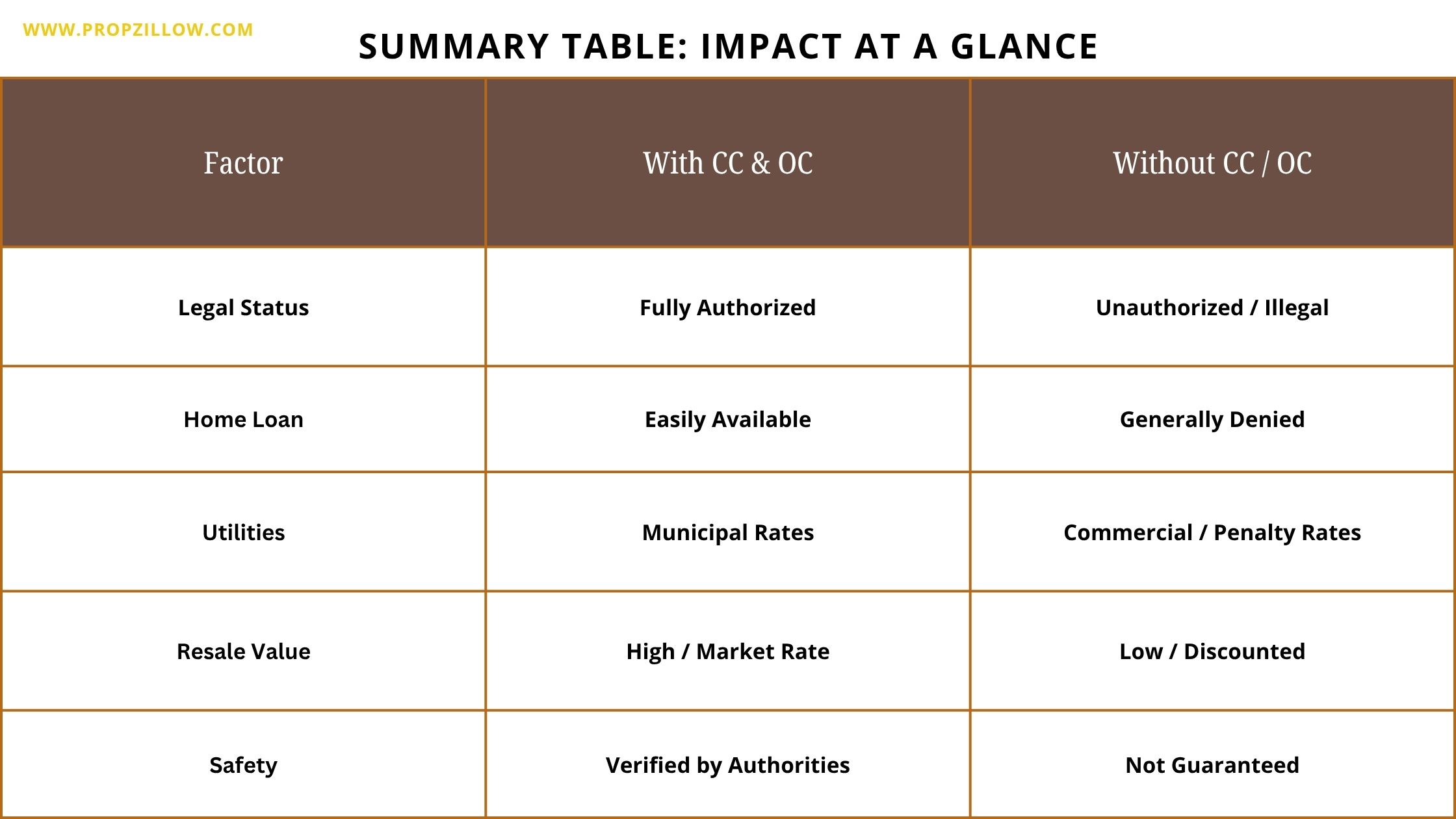
The impact of CC and OC on a property is the difference between a legal asset and a legal liability. Without these documents, a property is essentially a shell that you cannot officially own or live in.
Here is how they impact various aspects of your investment:
Financial Impact (Value & Loans)
- Property Valuation: A property with a valid OC generally commands a 20-30% premium over one without it. If a building lacks an OC, its market value drops significantly because it is considered “unauthorized.”
- Loan Rejection: Banks will almost never approve a home loan for a “ready-to-move” property that lacks an OC. If you are buying in resale, the absence of an OC is an immediate deal-breaker for any mortgage.
- Resale Liquidity: Selling a non-OC property is incredibly difficult. Most informed buyers will walk away, leaving you with an asset that is hard to liquidate.
Legal & Ownership Impact
- Illegal Occupation: Moving into a flat without an OC is technically illegal. Municipal authorities can issue eviction notices (as seen in many cases across Delhi-NCR) even if you have paid the full amount to the builder.
- Incomplete Title: You cannot legally execute a Sale Deed or register the property in your name in the government records (Tehsil) without the OC. This means you don’t “own” the property in the eyes of the state.
- Demolition Risk: If a builder fails to get a CC or OC because they deviated from the approved layout, the local authority (like GMDA or MCG) has the power to demolish the unauthorized portions of the building.
Utility & Infrastructure Impact
- Commercial Rates for Utilities: Without an OC, the building may not get a permanent connection for water or electricity. Residents often have to pay commercial rates for these services or rely on expensive water tankers and diesel generators.
- Property Tax: In many jurisdictions, properties without an OC are charged much higher property tax rates as a penalty for unauthorized occupation.
RERA Protections
- Builder Accountability: Under RERA, a builder cannot officially “offer possession” without obtaining the OC.
- Delayed Interest: If a builder asks you to take possession without an OC, you are legally entitled to refuse and can claim interest for the delay until the OC is actually obtained.
Never accept a “Possession Letter” from a builder unless it is accompanied by a copy of the Occupancy Certificate. Possession without an OC is just a “key handover” with no legal standing.
Join The Discussion